
Biobank Circular Plastics: Staying Ahead Of The Next Pandemic
April 22, 2026, 10:07 GMT
Innovation in global health isn’t just about discovery—it’s about reimagining the systems that support it. Through the BioPREVAIL Built Environment Design Challenge, one standout team is demonstrating how sustainability and preparedness can go hand in hand. Their project, “From Waste to Workbench: A Circular Lab Story,” tackles a growing but often overlooked challenge in laboratory environments: plastic waste.
At the Institut Pasteur du Cambodge (IPC), where pandemic preparedness is central to daily work, the team operates with a clear mission rooted in the One Health approach—recognizing the deep connections between human, animal, and environmental health. Their question is both simple and urgent: how can we design better systems that improve health outcomes while also caring for the planet?
The answer begins with a problem hiding in plain sight. Nearly 50% of waste generated at IPC is plastic, much of it from laboratory operations. Compounding the issue are inefficiencies in storage—non-stackable containers, loose lids, and improvised tools that take up valuable space and drive up costs. In high-demand environments like biobanks, where sample integrity and organization are critical, these challenges quickly escalate.
(Source: Biobank Circular Plastics)
Led by Sofia Perez and Hokkean Lim, the group brings together expertise across laboratory operations, sustainability, and design. Their solution is a circular system that transforms plastic waste into functional laboratory supplies using accessible, locally adaptable technologies. It’s a closed-loop approach that not only reduces waste, but actively strengthens lab capacity.
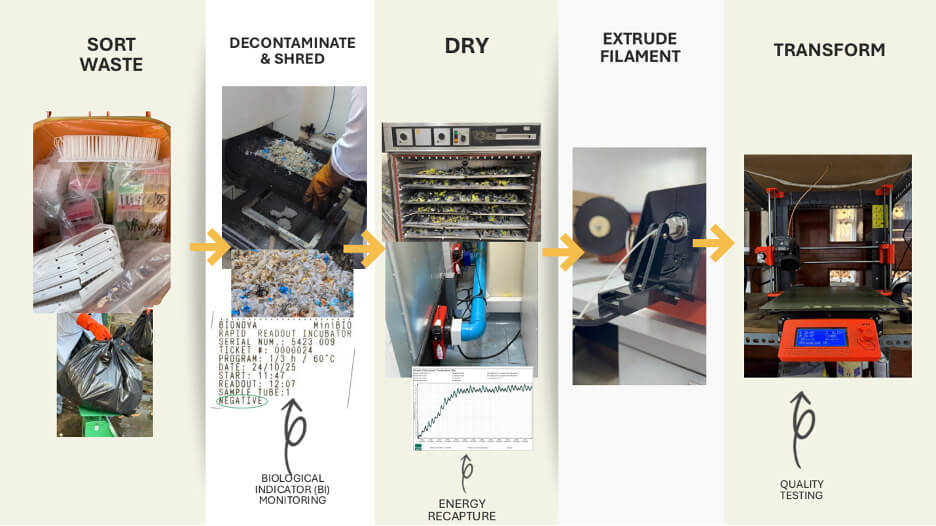
The process is both practical and innovative. Plastic waste is sorted, decontaminated, and shredded before being dried and extruded into filament. That filament is then used to fabricate new lab tools and supplies—from cold storage racks to sample transport containers and modular labware holders. Each product is designed with real-world use in mind: stackable, space-saving, and equipped with secure lids to improve storage and safety.
What makes this system especially powerful is its flexibility. All components are designed and fabricated locally in Cambodia, allowing for customization based on specific lab needs. Color-coded designs improve organization, while specialized add-ons—like sliding fridge tracks and magnetic racks—enhance usability. Beyond core lab functions, the system also supports broader applications, including educational tools and maintenance supplies.
Quality and safety remain central throughout the process. Biological indicator monitoring and quality testing ensure that recycled materials meet rigorous standards, while energy recapture strategies improve overall efficiency. The result is a system that is not only sustainable, but also reliable and scalable.
The impact extends far beyond waste reduction. By lowering dependence on imported supplies, the model improves cost efficiency and strengthens local self-sufficiency. It reduces biological waste exposure, enhances storage security, and helps maintain sample integrity—critical factors in biobank management. Perhaps most importantly, it builds resilience. With the ability to rapidly produce and repair essential tools, laboratories are better equipped to respond to emerging health threats.
This work is deeply collaborative, engaging lab technicians, biobank managers, health and safety teams, and a broader network of over 30 Pasteur institutes across 20 countries. It reflects a shared commitment to innovation that is grounded in real-world needs and global impact.
Now, the team is looking ahead. With the right investment, technical partnerships, and pilot opportunities, this circular model has the potential to scale—transforming not just IPC, but laboratory systems worldwide.
Their message is clear: sustainability is not a constraint on scientific progress—it is a catalyst for it. And in the race to stay ahead of the next pandemic, solutions like this don’t just reduce waste—they redefine what’s possible.